
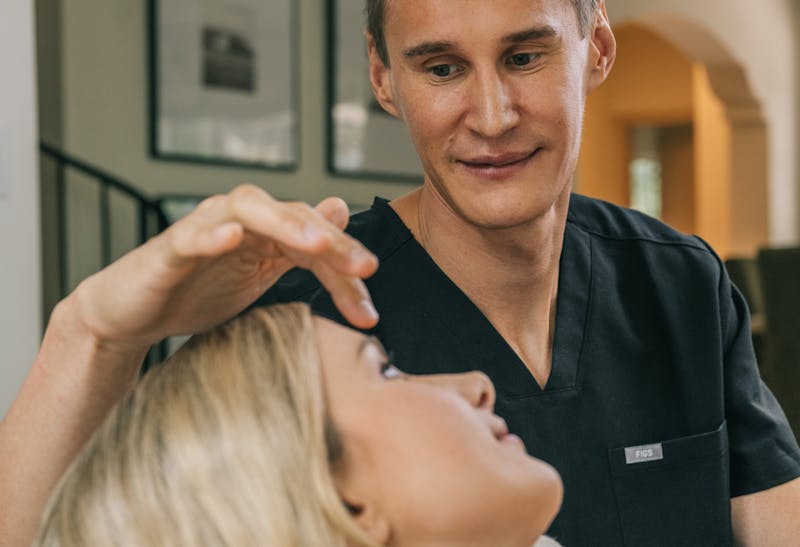
The eyes are often the first place to show signs of aging. When patients come to me complaining of looking "tired" or "puffy" despite getting a full night's sleep, the culprit is often the lower eyelid.
While lower eyelid surgery (blepharoplasty) is one of the most effective ways to restore a refreshed appearance, it is not a "one size fits all" procedure. Over the years, surgical techniques have evolved, and my personal philosophy has shifted toward methods that prioritize structural integrity and long-term safety.
Today, I want to explain the differences between the various techniques—Transconjunctival, Skin Pinch, and Conventional—and why I strongly favor a specific approach to ensure natural results.
THE "GOLD STANDARD": TRANSCONJUNCTIVAL BLEPHAROPLASTY
In my practice, the transconjunctival approach is my preferred method for the vast majority of patients.
Unlike older "conventional" techniques that cut through the skin and muscle on the outside of the eyelid, the transconjunctival approach places the incision inside the lower eyelid. This offers two distinct advantages:
- No external scar: The incision is completely hidden.
- Muscle Preservation: This is critical. I prefer not to disrupt the layers of the lower eyelid, specifically the orbicularis oculi muscle (the muscle that closes the eye). Cutting through this muscle, as is done in conventional open blepharoplasty, can weaken the eyelid's support, leading to a higher chance of complications and altering the natural shape of your eye. By approaching from the inside, we bypass the muscle entirely.
ADDRESSING THE "BAGS" AND TEAR TROUGHS
Simply removing the fat pads (the "bags") can sometimes leave the eyes looking hollow or gaunt. To avoid this, I typically combine the transconjunctival approach with fat repositioning or fat grafting.
- Repositioning: We take the patient's own eyelid fat and move it into the hollow "tear trough" area to smooth the transition between the lid and the cheek.
- Grafting: If there isn't enough local fat, we can harvest fat from elsewhere in the body to fill that hollow groove.
This volume management is what creates that youthful, smooth contour rather than a hollowed-out look.
HANDLING EXCESS SKIN: THE "SKIN PINCH"
While the transconjunctival approach handles the fat perfectly, it does not remove loose skin.
If a patient has a significant amount of excess skin, I may perform a "skin pinch". This involves removing a small strip of skin just below the lash line. Crucially, this is done without violating the muscle.
Conservative is Key. I cannot stress this enough: skin excision must be very conservative. The lower eyelid is unforgiving. If too much skin is removed or if the muscle is compromised, it can lead to:
- Rounding of the eyes: Losing the natural almond shape.
- Ectropion: Where the lower lid pulls down or flips outward.
My goal is always to avoid these complications. It is better to leave a tiny amount of laxity than to risk changing the shape of the eye or causing functional problems.
WHAT SURGERY CANNOT DO: TEXTURE AND FINE LINES
It is important to manage expectations regarding skin quality. Blepharoplasty changes the contour (the shape) of the eyelid, but it does not change the texture of the skin.
Surgery will not erase fine wrinkles, crepey skin, or dark pigmentation. If your main concern is the surface texture of the skin, surgery alone isn't the answer. To address these issues, I often recommend non-surgical adjuncts such as:
- CO2 Laser Resurfacing
- Chemical Peels
These treatments tighten the skin and smooth out fine lines in a way that scalpel surgery cannot.
THE PROCEDURE AND RECOVERY
Because I avoid disrupting the deep muscle layers, the recovery is generally smoother than with conventional open approaches.
- Anesthesia: The procedure is usually performed under twilight anesthesia. You are asleep and comfortable, but we avoid the heavy "hangover" of general anesthesia.
- Downtime: Most patients feel ready to resume the majority of their normal activities within 10-14 days.
- Healing: While you can be up and about quickly, it is normal for some bruising and swelling to persist for a few weeks as the tissues settle.
CONCLUSION
There is no single recipe that fits every face. The best approach is determined by your unique anatomy and specific cosmetic concerns. However, by prioritizing the preservation of the eyelid muscle and using conservative, precise techniques, we can achieve a result that looks bright, rested, and—most importantly—like you.
Authored by Dr. Alexey Markelov