

By Alexey Markelov MD FACS
While the lower eyelids often make us look tired or puffy, the upper eyelids tend to make us look "heavy." As we age, the skin on the upper lid stretches, and the muscles can weaken. This leads to "hooding"—where excess skin folds over the lash line—making the eyes appear smaller and sometimes even interfering with peripheral vision.
If you find yourself constantly raising your eyebrows to see better, or if your eyelid makeup disappears into a fold of skin moments after you apply it, Upper Eyelid Blepharoplasty is likely the solution you are looking for. However, sometimes the "heavy" look isn't just about the eyelids—it’s also about the position of your eyebrows.
What is Upper Eyelid Blepharoplasty?
Upper blepharoplasty is a procedure to remove excess skin and, if necessary, sculpt the underlying fat to restore a cleaner, more defined eyelid contour.
The goal is not to give you a "startled" look, but to reveal the natural platform of your eyelid that has been hidden by sagging skin. The result is a brighter, more alert appearance that looks completely natural.
The "Straight Local" Advantage
One of the distinct advantages of isolated upper eyelid surgery compared to other facial procedures is that it can often be performed under straight local anesthesia.
While some patients prefer twilight sedation to sleep through the procedure, many are surprised to learn that upper blepharoplasty is very well-tolerated while awake. Here is how it works:
- We numb the eyelid area completely using a local anesthetic (similar to a dental procedure).
- You remain awake and comfortable, but you will not feel any pain.
- This avoids the grogginess associated with general anesthesia and allows for a quicker discharge from the office after the surgery is complete.
It’s Not Just About Skin: Addressing the Fat Pads
While removing the redundant "hooded" skin is the primary goal for most patients, the underlying anatomy varies from person to person.
During your consultation, I evaluate the fullness of your upper lids.
- Skin Only: For some patients, the issue is purely lax skin. In these cases, we simply excise the excess skin to re-define the crease.
- Fat Pad Removal or Repositioning: Many patients have a bulge of fat, particularly in the inner corner of the eye (near the nose). If we only remove skin and ignore this bulge, the result may look incomplete or puffy. Depending on your specific anatomy, I may remove a small amount of this fat or reposition it to ensure a smooth, youthful contour. However, this is not always necessary; preserving volume is key to avoiding a "hollowed-out" appearance.
Before & After Photo
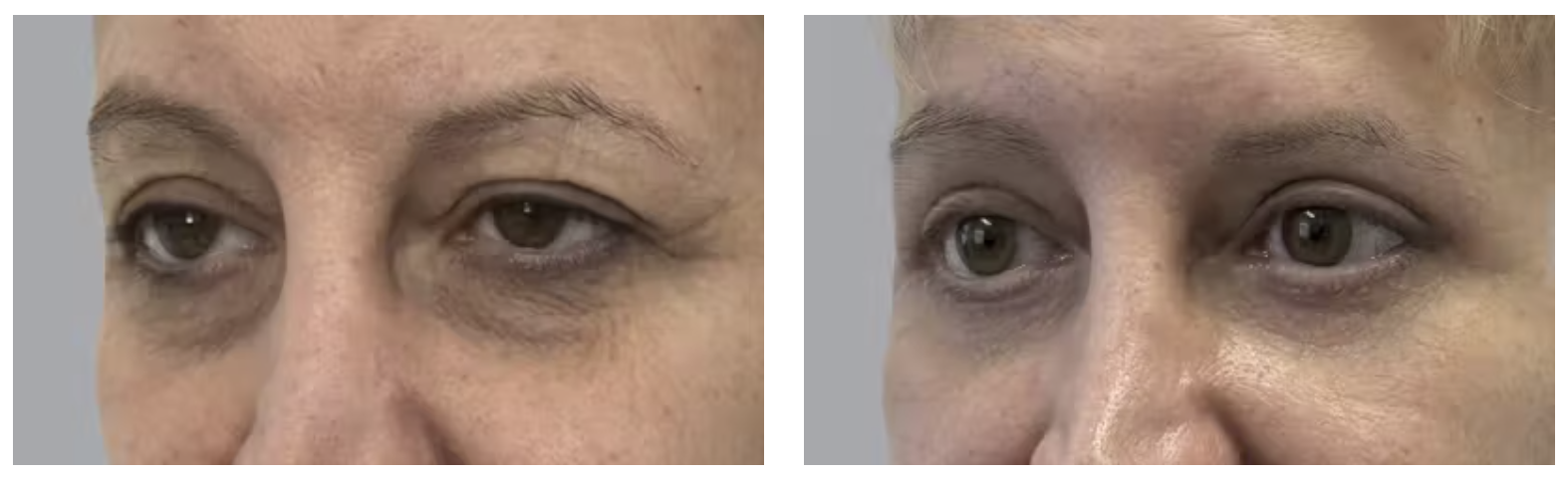
The Brow Factor: When to Add a Brow Lift
During our examination, I will also check for brow ptosis (drooping of the eyebrows).
Sometimes, what looks like excess eyelid skin is actually the heavy forehead pushing the eyebrow down, which in turn crowds the upper eyelid. If you have significant brow ptosis, simply removing eyelid skin might not be enough—in fact, it can sometimes pull the eyebrow down even further.
In these cases, we frequently combine the blepharoplasty with a Brow Lift. This restores the brow to a more youthful position and opens up the eyes even more effectively.
A Note on Anesthesia:
It is important to note that while a simple upper blepharoplasty can be done under local anesthesia, adding a brow lift typically requires general anesthesia. This allows us to safely and precisely elevate the brow tissue for a long-lasting result.
What to Expect During Recovery
Recovery from upper eyelid surgery (with or without a brow lift) is generally very manageable.
- Stitches: You will have fine sutures in the eyelid crease. These are typically removed in about 5 to 7 days.
- Scarring: Because the incision is placed within the natural crease of the eyelid, the resulting scar is extremely well-hidden and becomes virtually imperceptible over time.
- Downtime: You can expect some swelling and bruising. Most patients feel comfortable returning to public activities (perhaps with sunglasses) within a week, once the sutures are removed.
The Next Step
Upper eyelid surgery is one of the most high-impact procedures in plastic surgery. It effectively "opens up" the face and reverses the heavy, tired look of aging eyes.
The best approach—whether it involves just skin excision, fat handling, or a combined brow lift—depends entirely on your anatomy.
I invite you to schedule a consultation so we can differentiate between eyelid hooding and brow ptosis, and decide if local anesthesia or general anesthesia is the right choice for you.