

By Alexey Markelov MD FACS
As a plastic surgeon, one of the most common complaints I hear from patients is, "I look tired, even when I'm well-rested." The eyes are the focal point of the face, and unfortunately, the lower eyelids are often the first area to show signs of aging.
If you are frustrated by puffy bags, deep hollows, or loose skin under your eyes, lower eyelid blepharoplasty may be the solution. But it is not a one-size-fits-all procedure. Today, I want to walk you through what this surgery entails, what it can (and cannot) fix, and the advanced techniques I use to ensure a natural, safe result.
WHAT IS LOWER EYELID BLEPHAROPLASTY?
Lower blepharoplasty is a surgical procedure designed to rejuvenate the area between your lower eyelashes and your cheek. The goal isn’t to change the shape of your eyes, but to restore a refreshed, youthful contour.
WHAT IT IS GOOD FOR
This procedure is excellent for addressing structural changes under the eye, including:
- Under-eye bags: Bulging fat pockets that create a puffy appearance.
- Tear troughs: Deep creases or grooves between the eyelid and the nose/cheek.
- Hollowness: A sunken look that can create shadowing.
WHAT IT IS NOT GOOD FOR
It is important to have realistic expectations. Surgery addresses shape and volume, but it does not fix everything. Lower blepharoplasty generally does not correct:
- Fine wrinkles: Static lines or "crow's feet" often require neuromodulators (like Botox) or chemical peels.
- Skin texture: Crepey, paper-thin skin is better addressed with skin treatments.
- Dark discoloration: If your dark circles are caused by pigmentation (skin color) rather than shadows from bags, surgery will not change the color of your skin.
THE PROCEDURE: APPROACHES AND ANESTHESIA
The technique I recommend depends entirely on your anatomy.
1. THE "SKIN PINCH" (LOCAL ANESTHESIA)
For patients who have good volume and no bulging fat but just a small amount of excess skin, a "skin pinch" excision is a great option. This is a simpler procedure that can often be performed under local anesthesia. We remove a small strip of skin to smooth the area without manipulating the deeper tissues.
2. THE TRANSCONJUNCTIVAL APPROACH (SEDATION OR GENERAL ANESTHESIA)
For most patients, the problem lies deeper—in the fat pads. For this, I typically use the transconjunctival approach.
In this method, the incision is made inside the eyelid. This is a critical advantage for two reasons:
- No external scar: The incision is completely hidden.
- Safety: By going through the inside, we preserve the delicate muscles and support layers of the eyelid. This significantly minimizes the risk of eyelid retraction or ectropion (a complication where the lower eyelid is pulled down or turns outward).
Because we are working deeper to remove or reposition fat pockets, this approach requires twilight sedation or general anesthesia for your comfort.
ADDRESSING VOLUME: REPOSITIONING VS. GRAFTING
Historically, surgeons simply removed the fat bags. However, removing too much fat can leave the eyes looking hollow and gaunt. Modern techniques focus on preserving volume.
- Fat Repositioning: Instead of removing the fat, I can reposition it into the "tear trough" area to smooth out the transition between the lid and the cheek.
- Fat Grafting (Transfer): Alternatively, we can use fat grafting. This involves taking a small amount of fat from another part of your body and carefully injecting it into the hollow areas to provide natural, long-lasting volume.
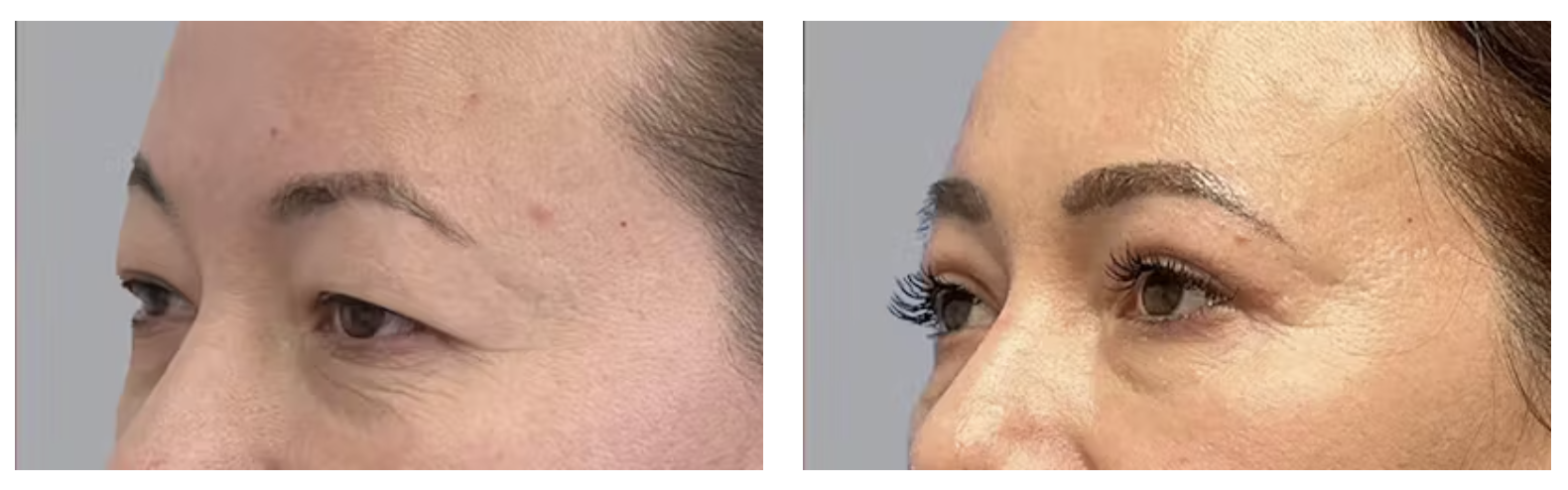
Before & After
HANDLING THE SKIN
If you have minor skin texture issues, we can combine the surgery with laser resurfacing to tighten the skin. If there is significant excess skin that cannot be fixed with a laser, a conservative incision just below the lash line (subciliary incision) may be required to trim the excess.
RECOVERY: WHAT TO EXPECT
Recovery from lower blepharoplasty is relatively easy, though you will need some social downtime.
- Bruising: You can expect bruising around the eyes, which typically resolves within 2 to 3 weeks.
- Swelling & Chemosis: Swelling is normal. You may also experience a condition called chemosis, which is swelling of the conjunctiva (the clear covering of the eye). It can look like a blister or bubble in the corner of your eye. While it can look alarming, it is not dangerous and usually resolves on its own as the eye heals.
THE NEXT STEP
The exact technique—whether it’s a skin pinch, fat repositioning, or fat grafting—is dictated by your unique anatomy and aesthetic desires.
If you are tired of looking tired, I invite you to schedule a consultation with me. We will examine your eyelids, discuss your goals, and create a tailored plan to restore a brighter, more rested look to your eyes.